
Claudia and James‘s Jewish wedding in Mykonos | Photo by Anna Roussos
This is a guest post by Michelle Jacobs. The founder of Elegante by Michelle J, Michelle is a wedding planner with a niche specialisation in luxury destination weddings in Europe for UK and US based Jewish couples. Her mission is to create magical and memorable weddings for her couples, their families and their guests. Michelle has had the privilege of working at numerous European venues and has built fantastic relationships and effective collaborations with a whole host of talented and professional wedding vendors. She is passionate about sharing all of her knowledge and experience to create your dream wedding.
As destination wedding specialists, we are firmly on ‘team travel’ – nothing beats the opportunity to bring your loved ones together in a beautiful place for quality time together. Planning a destination wedding gives your guests an immersive occasion that everybody present will have in common for the rest of their lives. That is why we plan with memorable moments in mind, and why we’re not surprised that more and more couples are considering marrying abroad. It is, however, a decision you should go into with your eyes open – so these are the 17 things nobody tells you about planning a destination wedding.

Chhaya and Harry‘s Hindu-Jewish Wedding in Spain | Photo by Dmitry Komarenko
Start by setting your expectations about who will come to your destination wedding
One thing I always tell my couples is that you can’t expect everyone on your guest list to be as excited about your destination wedding as you are. Inviting someone to drive half an hour down the road to a wedding in your hometown is not a huge ask, whereas inviting them to travel to a different country, incur the expense of getting and staying there, and take several days out of their lives is.
We advise our couples to try not to be disappointed if guests that you had expected to attend choose not to. Even if you think ‘they can afford it, we don’t know why they’ve said no’, everyone has different priorities for where they spend their money and time.
On the plus side, your guest numbers are likely to end up smaller which means your budget stretches further. You will also end up with people who really matter at your wedding, while those on the periphery of your lives are likely to politely decline.

Natalie and Marc‘s Jewish Wedding in Rome | Photo by Alex Wysocki
Think about your VIP guests and whether they can travel
With all of that said, it is important to think about anyone important to you that might not be able to make the trip if you’re planning a destination wedding. A great example of this is when couples have elderly grandparents, and we do have some couples who choose to stay closer to home to ensure they can attend.
We have other couples who go ahead with their destination wedding, but then make sure their grandparents are included in other ways – making more out of the civil ceremony that happens at home, prior to the overseas celebration, for example and / or the aufruf.

Paige and Richard‘s Jewish Wedding in Florence | Photo by David Bastianoni
You need to really look after your guests
Having established that everyone who attends will spend a significant amount of money and time, we advise making everything as effortless for your guests as possible.
We want everyone to feel excited, relaxed, and completely looked after. This is a priority in the destination wedding planning service we offer. As well as designing, planning and producing your wedding, we look after you and your nearest and dearest. All of our couples get complimentary access to our premium travel concierge service, Terrazza Travel, a dedicated team that makes booking their flights, hotels, transfers and cars easier than finding the perfect outfit for your wedding.
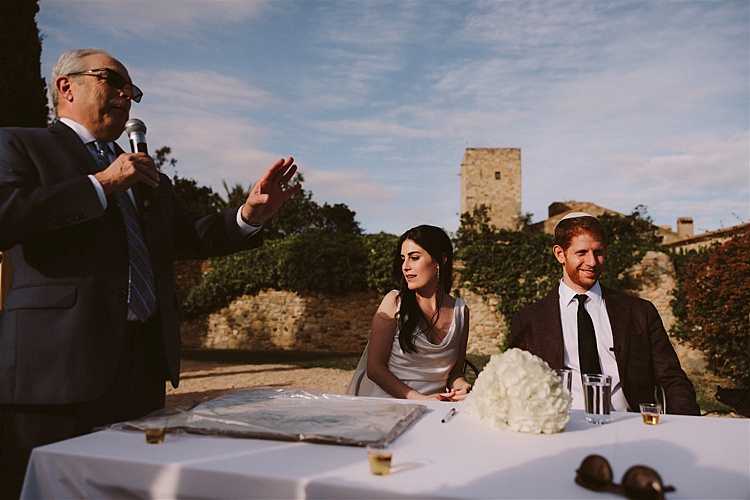
Talia and Nadav‘s Jewish Wedding in Spain | Photo by People True Love Tellers
This is why it’s so important to choose your location carefully
When you decide where to get married, choose a location that’s easy for your guests to get to. Major airport hubs are a big advantage, as are areas with a range of different hotel types. If you’ve fallen in love with a venue in the middle of nowhere, we’re not saying you shouldn’t get married there. You just need to consider other ways to make things easier for your guests.
A great example is couple Talia and Nadav, who chose a beautiful venue two hours outside of Barcelona. Rather than asking their guests (many of whom were coming from the US) to travel another two hours after a long travel day, we hosted a welcome celebration in Barcelona on night 1. Welcome drinks and snacks followed a tour of the Gaudi La Pedrera, giving everyone a chance to decompress before the arranged coach to the wedding location the following day.

Aviva and Alan‘s Jewish Wedding in Tuscany | Photo by David Bastianoni
How should you choose your destination wedding location?
Some couples come to us for planning a destination wedding and they already know where it’s going to be – somewhere meaningful, perhaps somewhere they’ve holidayed a lot, where the proposal happened, or where there’s a family connection (like Emily and Avery whose welcome party took place at her grandfather’s house in Portugal!).
Other couples know they want the destination wedding experience, but don’t have a particular place in mind. That makes it much harder to decide. If there is no meaningful connection to anywhere, you have the whole of Europe to choose from and it’s like looking for a dropped engagement ring on a sandy beach…
Of course, if you’re working with an experienced destination wedding planner, either of these two approaches works. As experts in Mediterranean Europe weddings, we can work with you to find the perfect place to bring your loved ones together – meaningful connection or no.
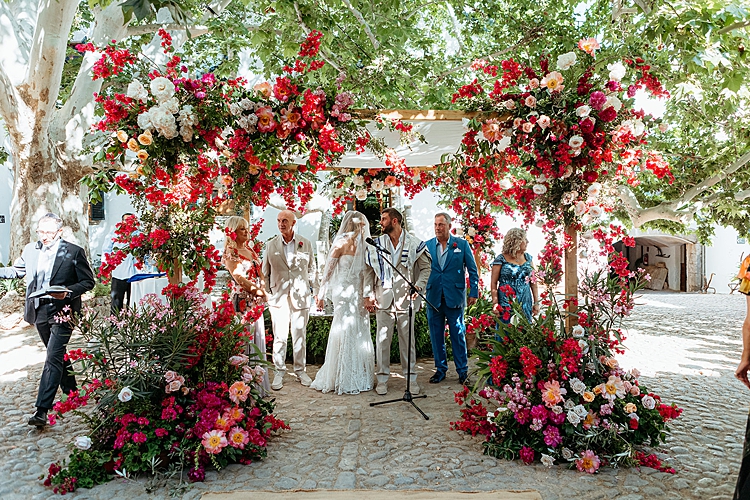
Katie and Tom‘s Jewish Wedding in Spain | Photo by Violeta Minnick
Should you work with a local planner or one from your home country?
While there are wonderful wedding planners in all European countries, our advice would be to work with someone in your home country who specialises in destination weddings – like us.
Some of the benefits of working with Elegante by Michelle J are:
- We work in your language
- We know how to plan your wedding overseas remotely, with strategic planning trips to be ‘on the ground’ when necessary
- We also provide a travel concierge service
These are all things you may not get with a local planner in your host country. We recommend speaking to planners in both categories before making your decision. All too often we pick up weddings partway through the planning journey, where couples have first gone to a local planner and it hasn’t worked out for whatever reason – this can involve a lot of unravelling, which costs you more in the long term.
If you’re concerned about your planner being able to speak the language in your destination country, Elegante by Michelle J gives you the best of both worlds. We are based in the UK and are an English-speaking team, however we always have a planner with us who speaks the local language. In Italy, we have a permanent member of the team available to assist us at all times.
Explore destination weddings in Europe with Elegante by Michelle J.

Aviva and Alan‘s Jewish Wedding in Tuscany | Photo by David Bastianoni
Destination weddings aren’t automatically cheaper
Many couples planning a destination wedding assume it will be cheaper – perhaps because they realise they will have fewer guests, or because of the misconception that weddings in Italy or Spain or Portugal just cost less than in the UK or US. This isn’t necessarily true.
Certain things might be less expensive: for example, if you choose a rural venue in the middle of nowhere the hire may well cost you less than a wedding at The Savoy in London, but you must factor in the costs of getting guests there on coaches, hiring in furniture, bringing in a production team and so on.
Don’t assume a destination wedding will be cheaper, and if this is your main motivation for going abroad be clear with your wedding planner.

Chhaya and Harry‘s Hindu-Jewish Wedding in Spain | Photo by Dmitry Komarenko
You will (almost) inevitably host more than one event
Another thing that increases the cost of planning a destination wedding is that you’ll likely have a minimum of two events over several days. Some of our couples have as many as four or five events. Every event means a meal for your guests, a table, a chair, possibly some entertainment and decor, music… so while each event won’t cost as much as the wedding day itself, there are certain unavoidable costs associated with multiday celebrations.

Natasha and Marc‘s Jewish Wedding in Tuscany | Photo by James Mason
The additional costs nobody tells you about
There are other extra costs involved in planning a destination wedding, such as:
- Your own travel to and from your wedding
- Your accommodation at your wedding
- Costs of the planning trips – you typically have at least two with us, which should be arranged for midweek when your suppliers are available to meet with us
It’s important that you factor this in outside of your specific wedding budget, and that you have the capacity in your holiday schedule to take two or three days out for your wedding planning.

Aviva and Alan‘s Jewish Wedding in Tuscany | Photo by David Bastianoni
Don’t just copy & paste the wedding you’d have at home
We advocate to our couples planning a destination wedding that you shouldn’t try to replicate what you would have done in your home country. Instead, embrace the charm of your chosen location – if you’re in Italy, you could have a welcome party themed around aperitif hour, in Spain an immersive food market with local dishes, or a Greek ouzo station with a sea view.
You can then include your own personal customs and traditions that are meaningful to you, blending the two to create a wedding that could only be yours.

Chhaya and Harry‘s Hindu-Jewish Wedding in Spain | Photo by Dmitry Komarenko
When to work with local suppliers and when to fly them in
At Elegante by Michelle J we advocate working with local suppliers wherever possible, supporting the local economy and doing your bit on the sustainability front. There is plenty of incredible talent in the European wedding industry, and we have connections with a wonderful network of people across the Mediterranean.
In some cases though, you won’t find what you’re looking for overseas. A prime example is entertainment – when we are looking for something very specific, for example a band for a Jewish wedding, we often can’t find a right-fit option locally. It’s the same with officiants, for example Rabbis, and some brides also choose to bring their hair and makeup artists from home simply because it’s easier to arrange trials.
Everything else, such as catering, production and floristry, we try to source overseas. If you’re hosting a wedding in Italy, for example, the absolute best thing you can do is have an Italian caterer – the food is better than anywhere we’d find at home! We can also get kosher catering overseas – but in the style of the local cuisine.
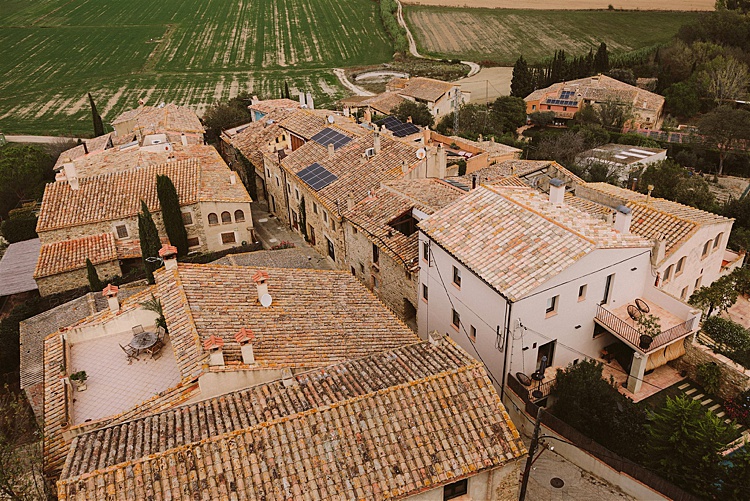
Talia and Nadav‘s Jewish Wedding in Spain | Photo by People True Love Tellers
Plan extra days around your destination wedding
We, your planning team, always fly in to your destination the day before the first event – this way if there are any issues or delays with flights we don’t get caught out. We’re on the ground, we’re rested, and we’re ready to deliver your celebration of a lifetime. For you as the hosts, we recommend arriving even sooner than that.
As your guests start to arrive, it’s nice if you are already settled and able to greet them. We also suggest you don’t fly home immediately the morning after your wedding, even if you’re not hosting a post-wedding event. The day after should be reserved for reveling in all the fabulous memories and saying goodbye to your loved ones, not hurriedly packing your suitcase and checking out of your room (possibly with a hangover!)

Aviva and Alan‘s Jewish Wedding in Tuscany | Photo by David Bastianoni
One place you shouldn’t scrimp if your budget starts to run low…
If you’re looking to cut something to save some money, arguably the worst place you can do this is by deciding not to provide transport to and from your wedding. We’ve already touched on the importance of looking after your guests, and this is especially important if your venue is in a difficult location where there is no Uber or local taxi service readily available. Even if there is a local taxi service, you’re probably looking at upwards of 100 people trying to hail the same 5 taxis in a small rural town…

Chhaya and Harry‘s Hindu-Jewish Wedding in Spain | Photo by Dmitry Komarenko
And one cost-saving tip
If you are looking for somewhere to save money, many couples like to give a favour or welcome gift. Rather than buying overpriced trinkets, spending an unreasonable amount on jars of local olives or working with a stationer to produce a welcome guide, by far the most appreciated gifts are handwritten notes.
I know it’s a big job, but we’ve seen it time and time again – guests love them, and it really shows how grateful you are that they made the effort to come to your wedding.

Katie and Tom‘s Jewish Wedding in Spain | Photo by Violeta Minnick
The question of guest hotels – who pays?
Couples often ask us whether they are obligated to pay for their guests’ accommodation. The reality is that the vast majority of our wedding couples don’t. It is therefore important to choose a venue that either has rooms on site that are affordable for all guests (or you can do some subsidising if not), or you choose multiple hotels in the area for guests that range from more basic budget options up to five star luxury. Our travel concierge service is built to help you with this, as well as to negotiate discounted group rates and secure blocks of rooms.
Some couples are able to cover their guests’ accommodation, and of course this is a very, very nice gesture. If you do go this way, you need to make sure you get a solid commitment first. You might find that if guests have not paid for a room, they feel less like they have to show up to your wedding. In this case you could charge a nominal amount for the room, or ask for guests’ flight details so you have evidence they’re committed.

Aviva and Alan‘s Jewish Wedding in Tuscany | Photo by David Bastianoni
It’s easier to do your legal wedding at home before you travel
Most of our couples choose to do a civil ceremony in their home country before going overseas for their destination wedding. The ceremony we do in your chosen country is then symbolic, whether that’s a Jewish wedding ceremony or a non-religious, celebrant-led one. To your guests, it doesn’t look any different – the only difference is that your paperwork is formalised in the UK before flying out.
Of course legal weddings can be done overseas, but it is a complicated process. It can cost thousands, and require solicitors and translators. My professional opinion is that it’s just not necessary, when you can do a simple civil wedding at home, host a small lunch or dinner for 10-20 of your closest friends and family, and start off your wedding celebrations in a lovely, intimate way.
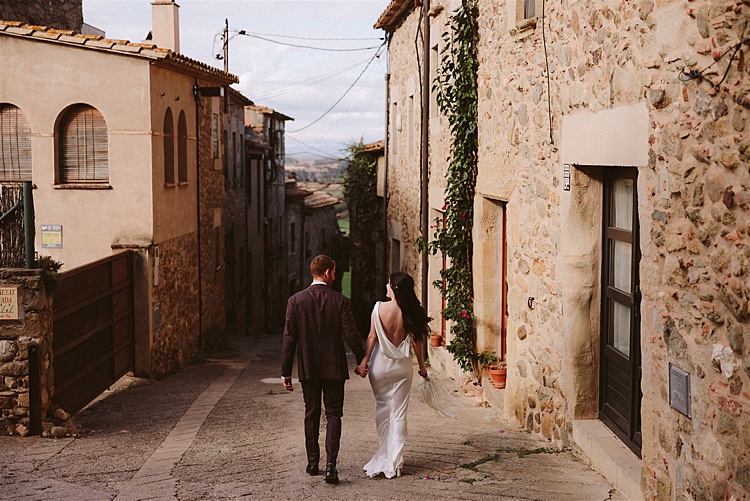
Talia and Nadav‘s Jewish Wedding in Spain | Photo by People True Love Tellers
I am often asked, with all of this in mind, which day couples should then celebrate their anniversary. My answer is this: when you were born and your parents went to the registry office to register your birth, they will have done so any time in the weeks following. It doesn’t have to be done on the day you are actually born. This doesn’t mean you celebrate your birthday on the day that your birth certificate is issued and dated – you celebrate on the day you were born!
Therefore, I recommend celebrating your wedding anniversary on the date that we host your destination wedding.

Natasha and Marc‘s Jewish Wedding in Tuscany | Photo by James Mason
Don’t underestimate the amount of work involved in pulling off a destination wedding
Planning a destination wedding is a wonderful experience, celebrating one even more so. But it’s important not to underestimate just how much work goes into making it look put-together, considered and effortless. Even more so than if you’re marrying at home, we recommend working with a wedding planner for an overseas wedding.

Aviva and Alan‘s Jewish Wedding in Tuscany | Photo by David Bastianoni
GET IN TOUCH if you’d like to talk to us about planning your destination wedding in Mediterranean Europe.

Leave a Reply